

Header graphic for print

Lawful Libations

Legal Updates & Commentary for Vineyards, Breweries, Distilleries & Farmers

New TTB Ruling Eases Restrictions on Designation of “Estate Bottled”

Posted in Labeling and Advertising, Legislation, TTB, Wine Law

Potential purchasers and sellers of wineries that produce “estate bottled” wines can breathe a sigh of relief thanks to a recent change in position of the TTB.  The TTB has defined “estate bottled” to mean “that 100% of the wine came from grapes grown on land owned or controlled by the winery, which must be located in a viticultural area. The winery must crush and ferment the grapes and finish, age, and bottle the wine in a continuous process on their premises. The winery and the vineyard must be in the same viticultural area.” See http://www.ttb.gov/pdf/brochures/p51901.pdf

Until recently, the TTB has advised wineries that if control in ownership of a winery changed at any point during the winemaking process the wine produced therefrom could not be designated as “estate bottled” as the new owner did not control all phases of the process.

However, in a recent ruling, the TTB now suggests wine may be labeled as “estate bottled” even if the ownership interest in the winery changes hands as the wine processes, so long as the bottling winery remains unchanged. The ruling also clarifies that “controlled by” refers to the land on which the grapes are grown and which the winery operates, not the owner of the land. The estate land is not affected by the sale of the winery and as such the new owner may continue to use the designation of “estate bottled”.
TTB Clarifies Use of “Serving Facts” Panels

Posted in Labeling and Advertising, TTB

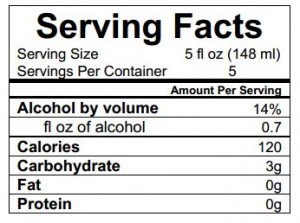
This month, TTB updated its FAQs with additional guidance for how producers of wines, spirits, and malt beverages can display “Serving Facts” panels in their labeling and advertising.  These FAQs clarify a Ruling issued by TTB last year allowing producers to voluntarily label their products with Serving Facts panels.  TTB explained that while it was engaging in formal rulemaking to determine whether it should make Serving Facts panels mandatory, in the meantime producers could voluntarily use the statements as provided set forth in the Ruling:

TTB believes that it is appropriate to allow the use of optional Serving Facts statements on labels and in advertisements on an interim basis pending the completion of rulemaking.  We are making this change to allow industry members to provide truthful, accurate, and specific information to consumers about the nutrient content of their products on a per serving basis.

Under the Ruling, producers can label and advertise their products with Serving Facts panels containing the following information:

  • serving size,
  • the number of servings per container, including, per serving size, the
    • number of calories,
    • grams of carbohydrates
    • grans of protein, and
    • grans of fat.
An example provided by TTB

An example provided by TTB

TTB further ruled that a producer may not state the caloric and carbohydrate content of the product “unless it provides complete information about the calorie, carbohydrate, protein, and fat content of the product.”  Finally, producers were not required to obtain a new certificate of label approval so long as the formatting of the Serving Facts panel matched those examples attached to the Ruling.

This month, TTB provided answers to ten frequently-asked questions related to the Ruling.  It provided additional example Serving Facts panels it finds acceptable for voluntary use and explained further how serving size statements may be  made.  It’s a good idea for any producer considering incorporating a Serving Facts panel into their labeling to read the Ruling and FAQ.  As I explained in a previous post, federal rulemaking by regulatory entities such as the TTB can be a slow process, so any requirement as to use of a Serving Facts panel may be a ways off.  But TTB may from time to time issue further clarification on the voluntary use of these panels in the future, so stay tuned.

TTB Suspends Wine Growler Ruling

Posted in Labeling and Advertising, TTB

TTB announced it is suspending its Ruling 2014-3, which among other things, held that businesses filling wine growlers needed to be approved as “taxpaid wine bottling houses” and label their growlers according to federal regulations.  I discussed this Ruling briefly in a previous post.

In its April 25, 2014 announcement, TTB explained that, in response to comments from actors in the industry, it decided to engage in formal rulemaking before deciding the issue.  As a part of this (often slow and deliberate) process, TTB will solicit comments from producers, consumers, state regulators–really, anyone–wishing to weigh in on the topic, with the goal of “modernizing” its regulations.  TTB’s first step will likely be to publish a Notice in which it will invite comments on the relevant topics.

Be sure to check the blog in the future; I will post a link to the Notice when it’s up.

Time Running Out to Apply for Funding From the USDA

Posted in Funding, Grant, Specialty Crops, USDA

There is still time to apply for funding through the United States Department of Agriculture’s Specialty Crop Block Grant Program, but not much.

The Program was designed to provide financial support to farms and farmers who produce specialty crops, i.e., grapes, hops, etc… Approximately $66 million in funding is available nationwide with $1.4 million earmarked for New York. In New York, the program is being administered by the New York State Department of Agriculture. If you are considering seeking funding from the program do not delay! Applications in New York must be received by Friday, May 2, 2014.

Applications to be considered for funding can be found here http://www.agriculture.ny.gov/AP/Slide/SpecialtyCrop.html.


Distillery Dragged into Trademark Lawsuit in Foreign State

Posted in Trademark

Hosting an engaging website can be a good way to extend the reach of your brand and provide a boost to revenue.  But it can also expand the number of jurisdictions in which you can be sued.  If you promote your product for sale outside of New York–even indirectly through a third-party website–you could be forced to litigate in a foreign state.

A Kansas distillery found that out this month, when a federal district court in Michigan ruled that the distillery could be sued there by a Michigan corporation.  In a case called Mor-Dall Enterprises, Inc. v. Dark Horse Distillery, LLC, a Michigan brewery sued a Kansas distillery for trademark infringement.  The plaintiff brewery did business as “Dark Horse Brewing Co.,” and began using the trademarks DARK HORSE and DARK HORSE BREWING COMPANY in connection with its beer since the late 1990’s.  About a decade later, the defendant distillery began using similar trademarks–DARK HORSE and DARK HORSE DISTILLERY–and filed applications with the U.S. Patent and Trademark Office to use those marks.  The brewery found out about those filings and sued for trademark infringement and unfair competition, under a federal statute called the Lanham Act.  The brewery didn’t sue in the distillery’s home state of Kansas, but instead on its home turf of Michigan (as plaintiffs generally like to do) in federal court: the Western District of Michigan.

Western District of Michigan (looking nice this time of year)

In an April 15, 2014 decision, the court didn’t rule on the underlying merits of the brewery’s case–whether the distillery infringed the brewery’s trademark or competed unfairly–but rather whether the court had jurisdiction over the Kansas distillery in the first place.  The court ruled that it did.

One way the distillery subjected itself to the foreign jurisdiction was found in its online promotional activities.  The distillery’s website was obviously accessible everywhere, including Michigan.  If the website were “passive,” and simply provided visitors with information about the distillery and its products, the distillery might have had a shot at getting the case dismissed for lack of jurisdiction.  But the website also informed visitors how to purchase its products.  While the distillery itself didn’t sell any of its products online, visitors could click a “Where To Buy” link, be re-directed to a third-party website, buy the distillery’s products there, and have them shipped to apparently any state (the third-party website was for a Brooklyn wine and spirits store).   The court ruled that even though the distillery didn’t “own or control” the third-party website, its efforts to sell its products in other states, including Michigan, meant it could not escape personal jurisdiction in Michigan.

So this case goes on.  It’s a good reminder to any New York producer: your website can expand your market, and the number of courts in which you can be sued, too.

FTC Releases Study of Statistics and Best Practices in Alcohol Advertising

Posted in Labeling and Advertising

In March 2014, the Federal Trade Commission released its “fourth major study” of alcohol advertising and underage drinking (FTC released similar reports in 1999, 2003, and 2008).  The report, titled “Self-Regulation in the Alcohol Industry,” discusses self-regulatory initiatives adopted by the Distilled Spirits Council of the United States, the Beer Institute, and the Wine Institute.  These three entities have promulgated “codes”–to which adherence is purely voluntary–as a means to self-police advertising in the industry.  The idea behind these codes is that if the alcoholic beverage industry can show FTC that advertisements are doing a good job of discouraging or preventing underage drinking, FTC does not have to create and enforce its own advertising standards.  Advertisers would rather regulate and police themselves, rather than being regulated by a potentially heavy-handed federal agency.

In the 100+ page report, FTC provides a variety of statistics concerning both traditional and social media advertising in the industry; it’s a good read for anyone interested in advertising in this space.  Data were collected from 14 “major alcohol companies” and assorted other sources.  A couple key figures include:

  • The major alcohol companies are devoting a good chunk of their advertising budgets to online and digital media, spending only four times as much money on traditional media as on online and digital.
  • Product placements are still being used–11 of the 14 major alcohol companies made 576 product placements in television and film.

The FTC also issued “conclusions” it “recommends” the industry adopt.  Self-regulatory entities often interpret these “recommendations” as directives; they want to remain in FTC’s good graces and secure FTC’s faith they are doing a good job setting boundaries for advertising.  In its report, FTC recommended:

  • Companies should focus attention correcting their advertising in media where “placement” compliance levels are below 90%.  The self-regulatory associations require that at least 70% of the audience for alcohol advertising placements be adults (roughly the percentage of the US population 21+ years of age).  In other words, consumers of the advertising shouldn’t skew towards minors.
  • In online and digital media, companies should make their “age gates” require visitors to enter their age, rather than merely certify they are 21 or over.  Companies should also make their privacy policies clearer to visitors.
  • FTC says two of the three self-regulatory associations in the alcoholic beverage space allow competitors to submit complaints about each others’ advertising.  The Beer Institute does not, and FTC says it should.
  • And more generally, alcohol companies should continue to “participate in cross-company efforts” to ensure compliance with the advertising codes.
I encourage any alcoholic beverage producer engaging in advertising on any budget to give this report and others like it a quick once-over.  Not only do these reports often reference best advertising practices in the industry, but they also provide a good sense of what other producers are doing and how they are focusing their advertising efforts.


New York’s “Tied-House” Laws (temporarily) Shut Down Eataly Wine Shop

Posted in ABC Law

New York City’s Eataly Wine Shop will soon be shuttered for a period of six months, as reported by Crain’s New York and other news outlets.  Why?  SLA had discovered that one of Eataly’s principals had been making wine in Italy.  This seems like a natural synergy and a great business opportunity–to marry a wine manufacturing business with a New York retail outlet.  But not all of these opportunities can be realized under New York regulation.  A brief look at New York’s Alcoholic Beverage Control Law (“ABC”) and a 2013 New York State Liquor Authority (“SLA”) Declaratory Ruling clears up the fairly simple rule.

New York regulation referred to as the “tied-house” laws prevents the marrying of the three main players–manufacturers, wholesalers, and retailers:

It shall be unlawful for a manufacturer or wholesaler licensed under this chapter to . . . [b]e interested directly or indirectly in any premises where any alcoholic beverage is sold at retail . . . by stock ownership, interlocking directors, mortgage or lien or any personal or real property, or by any other means.

SLA says that these restrictions are intended to prevent manufacturers from having “undue influence” over retail licenses and stores.  And the New York Court of Appeals observed in a case called RIHGA Intern. U.S.A., Inc. v. New York State Liq. Auth., 84 NY2d 876, 878 (N.Y. 1994) that the laws are designed for the “prevention of monopolies and other undesirable influences within the alcoholic beverage industry.”

Fair enough.  But what if the wine manufacturer in which a retail outlet has interest is a foreign entity?  And what if the wine store agrees with SLA that it will not sell wine from this foreign winery?  It would seem then that any antitrust fears would be quelled–after all, the retail store would not be selling any products from the winery in which it has an interest.

SLA says you can’t do this, and this is where Eataly ran into trouble.  SLA has denied such attempts by other entities in the past, most recently in a 2013 Declaratory Ruling.  Even though the entity there assured SLA its “retail business would not buy wine manufactured by [its] foreign wineries,” SLA said it has “no discretion to create an exception” to the clearly written tied-house laws, and instead “[s]uch action must come through amendments to the law.”  And just last month, perhaps recognizing it had no way around the tied-house laws, Eataly’s owners reached a settlement with the SLA that it would, among other things, suspend its retail license at Eataly locations and pay a $500,000 fine.

Will the “Cork Tax” Die on the Vine?

Posted in Legislation, Tax, Warehousing

Legislation currently pending in the New York State Legislature, the so called “at rest” law, would require wine and spirits to be sold in New York to be warehoused in the state for up to 48 hours before being available for sale.

Supporters of the legislation say that the proposed legislation will create jobs and make New York more competitive with states that currently have “at rest” laws on the books, like New Jersey and Connecticut. Opponents, however, argue that, if passed, the legislation would add up to $2 a bottle and could lead to layoffs and, in the worst case scenario, force smaller wholesalers to shutter their doors. These smaller wholesalers currently utilize warehouses in New Jersey where rent is much less expensive than in New York.

In response to the “at rest” legislation, a group of 37 New York wine and spirit businesses have formed the “Stop the Cork Tax” coalition.

This is not the first time that the Legislature has considered “at rest” bills. It will be interesting to see if the latest incarnation will suffer the same fate as earlier drafts and die on the vine.

For information regarding the “Stop the Cork Tax” coalition visit its website at www.stopthecorktax.com.

New York Liquor Authority Says “No” to Health Claims on Alcoholic Beverages

Posted in Labeling and Advertising

Since March 26, 2014, producers of alcoholic beverages may not make any “claim of health benefits to be derived from consumption” on labeling of wine, spirits, or beer, in New York.

In New York, labeling of alcoholic beverages is regulated by the State of New York Liquor Authority, pursuant to the Alcoholic Beverage Control Law (the “ABC”).  Before selling wine, spirits, or beer in New York, a producer must register labeling with the Liquor Authority.  On February 25, 2014, the Liquor Authority published in Advisory 2014-5 a set of proposed amendments to labeling requirements contained in the ABC, will take effect on March 26, 2014.  The Advisory explains that the ABC will require that brand labels contain:

  • The brand or trade name;
  • The class and type of alcoholic beverage;
  • The net contents of the container; and
  • All other labeling information required by TTB.

The Advisory helpfully explains in further detail the labeling content it requires, under each of the four bullet points above.

Importantly, not only does the Advisory set out items that must be included on brand labels, but it also names items that will be prohibited on brand labels.  One of those prohibited claims is: “Any statement or claim that the product has any health benefits.”  This is quite a blanket prohibition: a producer may not make any claims of health benefits, even if the claim is true.

This is in contrast to federal regulation promulgated by the TTB, under which producers may make health-related claims under certain circumstances–namely, if the claim is true and not misleading.  The TTB is the federal agency responsible for regulating labeling on and advertising for wine, spirits, and beer (see my prior post describing the agency).  The TTB issues its own sets of regulations, and producers wishing to do business in New York therefore must comply with regulations at both the federal and state levels.  If one agency imposes stricter regulations than the other, then the producer must comply with that regulation.

Given the health-consciousness of many consumers today, this is an important distinction to bear in mind for any producer wishing to sell in New York.

Looking Out for the Little Guy: BEER Act

Posted in Tax

In a surprising show of bipartisanship, House Democrats and Republicans have come to support a bill that would reduce the excise tax on beer by 50%, while providing additional benefits to small breweries.

The “Brewers Excise and Economic Relief Act of 2013,” or BEER Act, which was introduced in the House of Representatives by Congressmen Tom Latham (R-Iowa) and Ron Kind (D-Wis.), seeks to amend the Internal Revenue Code to reduce the excise tax on beer from its current rate of $18 a barrel to its pre-1991 level of $9 a barrel. Under the Act, breweries would pay no tax on the first 15,000 barrels produced each year and a $3.50 tax on barrels 15,001 to 60,000. All barrels produced above 60,000 will be taxed at $9.00 per barrel.

So, while all beer-producers would benefit from a 50% reduction of the tax on beer, craft breweries generating in smaller quantities would see a major decrease (or elimination) of their production-based taxes.  By reducing the tax rate to the lowest levels in 24 years, the Act would undoubtedly benefit breweries by easing tax burdens and reducing operating costs. Small breweries operating in Long Island (and elsewhere) would receive a slight competitive edge, potentially allowing each to compete with the larger national brands in their regional market.

Long Island’s largely eastern Suffolk county-based vineyards have traditionally dominated the landscape of regional beverage-producers.  However, many small, independent breweries have open their doors in recent years.  While many small breweries are founded without a great deal of financial backing, the potential tax breaks to be afforded by the BEER Act could help transform your local brewery into the next Blue Point Brewing Company, which transformed from a small Patchogue-based home brewing store to a major regional brewery that produces more than 30,000 barrels of beer annually.

While there is no guarantee that the BEER Act will become law, its introduction is a sign that the alcoholic beverage industry has significant support on the federal level.  Combined with new laws and regulations promoting industry expansion on the federal, state and local levels, the BEER Act signals a bright future for brewers on Long Island and elsewhere.  Stay tuned.